
Social
Education And Sustainability
Regarding our social capital, we believe in education as a tool to transform realities, with the possibility of impacting people’s ways of thinking and acting. Therefore, we develop and disseminate educational content with socio-environmental topics.
The main actions include:
- Educational courses and trails in the Corporate University for suppliers and partners, open courses for the community in general, as well as for public school teachers and students;
- Aligned with Brazil’s National Curricular Parameters (PCNs or Parâmetros Curriculares Nacionais) and the National Common Curricular Base (BNCC or Base Nacional Curricular Comum), we include sustainability in the development of our educational materials for K-9 education;
- Our complementary solution STEM Connect – Discovery Education promotes discussion around the 17 UN SDGs and society’s socio-environmental demands;
- We offer more than 170 environment-related graduate and postgraduate courses, such as a degree in environmental management and an MBA in environmental assessment, verification and audit;
- We have two postgraduate programs directly related to this topic: the Postgraduate Program in Environmental Sciences; and the Postgraduate Program in Environment and Regional Development. The programs maintain nine lines of research.
Social Impact
To guide our actions we have the Cogna Social Impact Platform, divided into priority fronts to enhance the power and reach of our initiatives:
Our programs are aligned with at least one of the three three pillars in our Social Impact Platform:
 Public Education
 Contribute to public education in the country.
 Economic Opportunities
 Change people’s lives through access to employment, helping them in their professional journey and in building their career.
 Local Development

 Promote economic and social development in the areas surrounding the teaching units.
These are transversal activity fronts that go beyond the pillars:
Innovation And Technology: To use new technologies to minimize negative impact and to leverage the positive impact of the businesses.
Diversity And Inclusion: To respect and value disabled persons; and promote equality in gender, ethnic origin, religion, sexual orientation and gender identity.
We believe in education as an instrument of social transformation, enabling people to achieve greater quality of life and to generate income in the places where they live. This is why it is our understanding that our presence in all the Brazilian states is a driver that boosts the positive impacts our activity has on society.
Given our capillarity, Cogna social measures are undertaken by means of community actions, projects and services offered by its higher education institutions and its three social arms: the Instituto SOMOS, the Fundação Pitágoras and the Aliança Brasileira pela Educação.
We have a Donations and Private Social Investment Policy (version PT-BR), that governs Cogna direct sponsorship and donation processes, formalizing the flows based on transparency and compliance requirements.
Service Learning
We see the potential of the actions of the teachers and students in our higher education institutions as an important element in transforming realities. This is why we have adopted service learning, experiential education to involve students in activities that fulfill human and community needs, together with structured opportunities for reflection to achieve the desired learning results.
We encourage the promotion of structured actions that serve the communities surrounding our campi. This involves the teachers and students dedicating hours of voluntary work to assist those who need it most.
Big Numbers 2025
Presence in Municipalities:
79%
are small (less than 100 thousand inhabitants over 17 years old).
+90%
have HDI below the Brazilian average.
In more than 220 municipalities,
Cogna is the only higher education institution present.
+ than 2,053
social projects carried out in 2025.
+ than 1 million of people benefiting from community services.
+ from R$ 300 millions of reais in tax relief for public authorities
There are two modes of activity:
- Social projects, which are initiatives undertaken for communities, aligned with the UN Sustainable Development Goals. They may be ongoing or isolated and may also be part of academic extension projects; Click here and find out about some of our actions already carried out! (PT-BR Language)
- Community services: these are undertaken systematically and continuously in social assistance spaces in our higher education institutions, with the Cogna graduate students providing specialized services in their areas of professional activity. Click here and see all community service locations! (PT-BR Language)

Created in 2017, Instituto Somos it operates as a non-profit organization committed to transforming the Brazilian educational landscape. Supported by SOMOS Educação, it is dedicated to democratizing education for vulnerable children and young people, believing that access to knowledge, reading, and the development of essential skills is the path to preparing new generations for the challenges of the future.
The Institute runs Somos Futuro, an acceleration program for children from public schools that improves their educational opportunities. The Somos Futuro is the anchor of our Corporate Volunteer Work Program: our employees participate as interviewers in the candidate selection phase – with responsibility for finding out about the lives of each individual. Later, they may accompany the education of the students working as mentors, supporting their adaptation to the new reality, their new colleagues and school routines, as well as helping them to develop socio-emotional competencies and plan their future and their career.
Somos Futuro Data for 2025
- 83 partner schools across 43 municipalities in 14 states;
- 229 young people currently in high school through the initiative, with 14% being beneficiaries of social programs such as Bolsa Família;
- 86 young people selected in 2025 to begin their studies in 2026;
- Over 280 students admitted to public and private universities since the program’s inception;
- 161 employees served as interviewers, 147 participated as mentors, and six shared their experiences during live online sessions for program scholarship recipients. These activities totaled 2,232 hours of volunteer work.
Learn more about Instituto Somos; click here [+] (PT-BR)

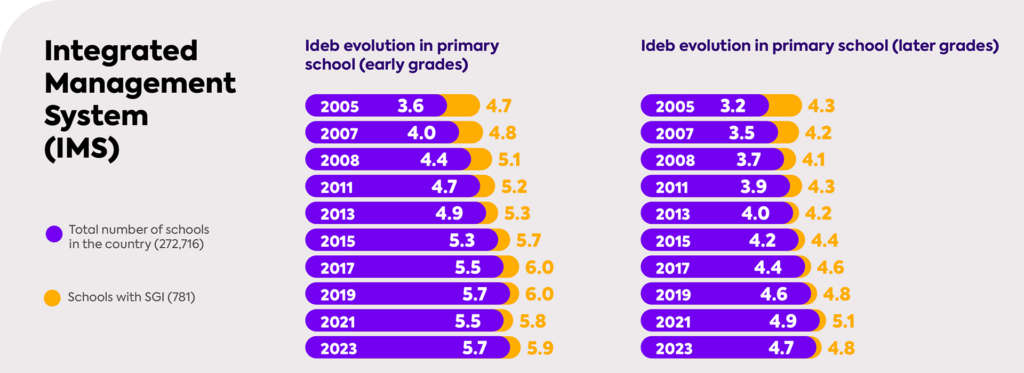
With a proprietary model developed for the public school networks, the Fundação Pitágoras seeks to drive improvements in learning by working with the entire school community. For around two years the Integrated Management System (IMS) accompanies the agents involved in schools, encompassing education departments, principals, educational coordinators, supervisors and teachers, who undergo training while incorporating the elements of school administration into their daily routines. Created 20 years ago, social technology underwent a digital transformation in 2021 with the adoption of a hybrid format: a major part of the program will be offered via distance learning while maintaining a number of strategic on-site meetings. The new model will enable the extension of this benefit to more schools in less time.
The teaching quality indicators prove the positive results of the program in the participating schools, as shown by the evolution of the IDEB (Basic Education Development Index), both in the initial and final years of the program. elementary School. Data from the latest available assessment, referring to 2023, indicate thatthe results are 0.2 points higher than the average for schools that do not have the SGI.
Guided by equity and inclusion—core values—the Foundation seeks to ensure that “no one is left behind” and believes that every individual is greater than their mistakes. In this spirit, it works to promote citizenship and dignity for individuals released from the prison system and those currently deprived of liberty through education. Prison education is viewed as essential for social reintegration; it fosters rehabilitation and reduces recidivism—key factors in breaking the cycle of violence and crime, which is often perpetuated by a lack of opportunities and vocational training after release. Focusing primarily on women, and partnering with institutions such as the National Council of Justice (CNJ), the National Secretariat of Penal Policies (SENAPPEN), and the Association for the Protection and Assistance of Convicts (APAC), the Foundation provides legal support and scholarships for vocational and distance learning courses.
The Foundation also leads the Mutirão das Árvores (Tree Planting Drive), a cross-sector alliance uniting public administration, private companies, and the third sector. The project operates in states such as Minas Gerais, São Paulo, and Espírito Santo, among others. In Minas Gerais, a notable initiative is the agreement to plant 100 million seedlings by 2032, with the goal of involving at least 80% of the state’s public schools. More than just a planting initiative, the project focuses on environmental education and the training of teachers and children. While private partners contribute resources and donate seedlings, the government coordinates efforts across various departments to handle pedagogical implementation and logistical support.